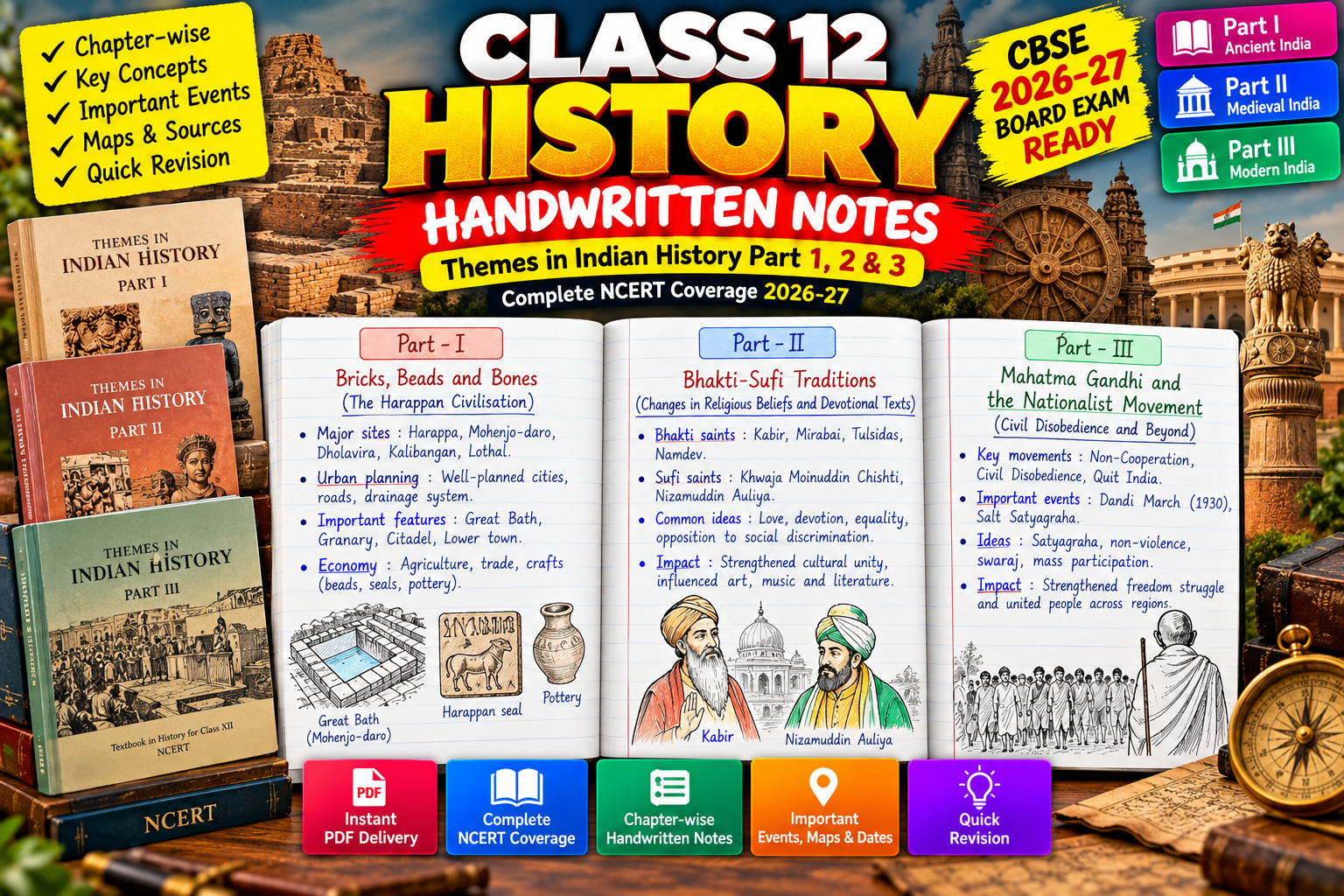
Prepare smarter for Class 12 History with complete NCERT-based handwritten notes covering Themes in Indian History Part-I, Part-II and Part-III. Get important events, concepts, historical sources, dates, personalities, maps, themes and exam-oriented points in a neat, easy-to-read handwritten format, designed for quick revision and effective CBSE Board Exam preparation.
Category: Handwritten
Tags: Class 12 HistoryClass 12 History NotesClass 12 History Handwritten NotesClass 12 Handwritten NotesNCERT Class 12 HistoryNCERT History NotesHistory Notes PDFClass 12 History PDFCBSE Class 12 HistoryCBSE History NotesClass 12 CBSE NotesHistory Revision NotesClass 12 Revision NotesClass 12 Board Exam PreparationHistory Study MaterialClass 12 History Study MaterialHistory Quick RevisionClass 12 Exam NotesHistory Important NotesThemes in Indian HistoryThemes in
Themes in Indian History – Part I, Part II & Part III
CBSE • NCERT • Board Exam Preparation 2026–27Prepare for your Class 12 History Board Exam with detailed, NCERT-based handwritten notes covering Themes in Indian History Part I, Part II and Part III. These are not just short revision notes — every theme is explained in detail and in an easy-to-understand handwritten format.
Each chapter/theme contains approximately 15–30 pages of detailed study material, depending on the topic. Important concepts are explained step-by-step with diagrams, maps, timelines, important dates, personalities, historical sources and exam-oriented points.
Neatly presented handwritten content with detailed explanations of important historical topics.
Each theme is covered in depth instead of providing only short summary points.
Key historical dates, events and timelines are highlighted for quick revision.
Important maps, locations, historical diagrams and visual explanations are included.
Key rulers, travellers, leaders, thinkers and other important historical personalities.
Important points and concepts useful for CBSE board examination preparation.
The Harappan Civilisation — Detailed study of Harappan cities, town planning, drainage systems, agriculture, crafts, trade, seals, pottery, social organisation and archaeological sources.
Early States and Economies — Important kingdoms, agricultural development, taxation, towns, trade, inscriptions and the development of early states.
Early Societies — Detailed explanation of family, kinship, marriage, caste, social classes and the interpretation of historical sources.
Cultural Developments — Buddhism, Jainism, religious ideas, stupas, monasteries, sculptures, architecture and important archaeological evidence.
Perceptions of Society — Accounts of foreign travellers, their observations of Indian society, culture, economy and political life.
Changes in Religious Beliefs and Devotional Texts — Bhakti movements, Sufi traditions, important saints, ideas, literature, devotional practices and their social impact.
Detailed study of Vijayanagara's political structure, architecture, Hampi, markets, temples, economy, society and historical sources.
Agrarian Society and the Mughal Empire — Rural society, peasants, zamindars, agriculture, revenue systems and Mughal administration.
Exploring Official Archives — Colonial land revenue systems, zamindars, peasants, rural society and the impact of British policies on the countryside.
The Revolt of 1857 and its Representations — Causes, major centres, leaders, events, British response, consequences and different historical interpretations.
Civil Disobedience and Beyond — Gandhi's political movements, Non-Cooperation, Civil Disobedience, Salt March, Quit India, mass participation and the freedom struggle.
The Beginning of a New Era — Constituent Assembly, debates, important members, constitutional principles, key provisions and the making of independent India's Constitution.
Get the complete Class 12 History Handwritten Notes PDF and study all three parts of Themes in Indian History with detailed explanations, important dates, maps, diagrams and exam-oriented content in one organised resource.
Is product ko sabse pehle rate karne ka mauka aapke paas hai.
Aapka experience doosron ko sahi choice karne mein madad karta hai.
Review likhne ke liye login karna hoga.